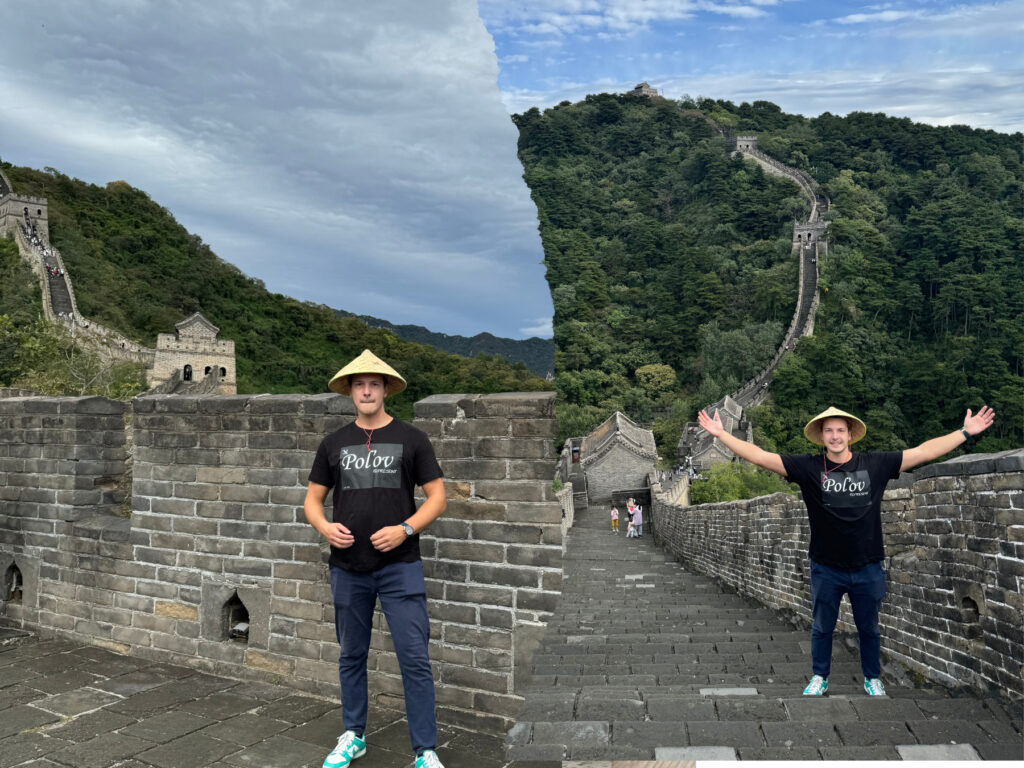

You might already guess where we were headed – I gave you a little hint in the previous part. This time, we set out to visit one of the Seven Wonders of the World – the famous Great Wall of China. And let me tell you, just the idea of walking on it gave me such an adrenaline rush, it felt like I was getting ready for a mission. But actually getting there? That was nowhere near as easy as it sounds.
Our plan was clear: get to the city of Huairou, located northeast of Beijing, and then continue by bus straight to the Wall. But first, we had to reach one of the main train stations in the northern part of Beijing, where trains to Huairou depart. From there, a bus was supposed to take us right up to the entrance of the Great Wall. It all sounded pretty straightforward – but reality quickly proved otherwise…
The Journey to the Great Wall of China
Well, it wouldn’t be us if something didn’t go wrong right from the start. We arrived at the train station – soldiers everywhere, strict supervision, and the whole place felt more like an airport than a train terminal. At the ticket window, we tried to explain to the lady that we wanted to go to Huairou, but she just looked at us and said: “Sold out.”
It was around 11 a.m., and the next available train wasn’t until 4 p.m. That would’ve meant losing half a day – which we definitely didn’t want. When we asked if there was any other way to get there, she just shrugged and said she had no idea – claiming she’d never even been there. And we’re just staring at her like: “It’s practically around the corner and you’ve never been? What is this?!”
Eventually, she told us to try the bus station right next door. Classic. We stepped outside, got lost in the crowds… and found absolutely no buses. Just as we were getting frustrated, Julka had a genius idea – she opened Didi Travel, the Chinese version of Uber.
And guess what – we actually found a direct ride to the Great Wall of China! Even though it was about 40 kilometers away, the total price was only around €12. For a comfy 45-minute ride down the highway, with views of Chinese hills and chaotic traffic. It was so ridiculously cheap that we just looked at each other in disbelief and thanked Julka for thinking to check the app.


The Taxi Ride and Arrival at the Great Wall
What completely blew my mind during the ride? The driver had a navigation app (classic), but it didn’t just show him the route – it even showed exactly how many seconds remained until the traffic light turned green. Even in the middle of the forest, where you’d expect only trees and silence. We were just shaking our heads in disbelief, and he kept smiling at us through the rearview mirror. He didn’t speak much English, so we used a translator – he spoke Chinese, I replied in Slovak or English, and somehow we made it work. It was actually a lot of fun, and the ride flew by in no time.
But hold on – I’ve got to rewind a bit. We almost didn’t make it to the train at all. Why? Classic me… I left my passport at the hotel. And in China, that’s a big mistake. The passport is your key to everything – without it, you can’t buy a train ticket, and forget about entering the Great Wall. So we had to quickly take the metro a few stops back to the hotel, grab my passport, and then rush back to the station. It was stressful, but we made it in time.
When we finally arrived at the Wall, the taxi driver dropped us off at the entrance gate. In front of us opened up a huge area with ticket stands and a choice to make – either hike up by foot, or take the cable car and enjoy the way down on the toboggan track.
Naturally, as true tourists, we chose the harder way – on foot. After all, something this iconic needs to be earned.

Climbing the Great Wall on Foot (and How We “Stole” a Hat 😅)
We decided to climb the Great Wall of China on foot – because a real traveler has to earn the view, right?
No cable cars, no shortcuts – just good old-fashioned stairs.
And let me tell you – it was worth the effort.
Every step up felt like a mini challenge, but once we reached the top, the feeling was incredible.
To have that ancient wonder beneath your feet and see the Wall snaking across the hills into the distance – it’s the kind of memory that sticks with you forever.
While we were waiting for the shuttle bus to take us up to the main gate, we stumbled upon a local market. Most of the sellers were elderly women offering everything from mini statues and bracelets to traditional Chinese hats.
Of course, we couldn’t resist and started trying on different styles and sizes. It was fun, and naturally, we tried a little bargaining – as any good tourist should.
And now comes the funny part – we were testing out one of the larger hats, and Rolo tucked it under his arm so it wouldn’t fall.
But while we were still negotiating prices and walking away, Julka whispered to us, “Quick, let’s go!”
Only later did we realize that Rolo still had the hat with him.
So we accidentally left the market with a little souvenir… completely for free.
Our hearts were racing at first, but we ended up laughing about it for the rest of the trip.


Why Was the Great Wall of China Built?
The Wall was built as a response to threats from the north. For thousands of years, Chinese dynasties had to defend themselves against invasions by nomadic tribes – mainly the Xiongnu (Huns) and later the Mongols.
The first sections began to be constructed as early as the 3rd century BCE, during the reign of Qin Shi Huang, the first emperor who unified China. However, it wasn’t originally one continuous wall – it was more like a network of smaller fortifications, which were gradually connected and rebuilt over time.


Ako dlho trvala jeho výstavba?
When you say “they built the Wall,” it sounds like it took just a few decades. But the truth is way more insane – construction went on for over 2,000 years across various dynasties. The biggest boom happened during the Ming dynasty (14th–17th century), when the most famous sections – the ones tourists visit today – were built. They used bricks, stone, and rammed earth, and millions of people worked on the Wall – from soldiers to prisoners.


A Size That Knocks You Off Your Feet
The Wall isn’t just “one wall.” According to modern measurements, the total length of all its sections is over 21,000 kilometers. That’s like walking halfway around the planet! And even though some parts have crumbled, the ruins and restored sections still stand as a massive symbol of human perseverance and the determination to protect a nation.

Mutianyu – Our Adventure Near Beijing
We headed to the Mutianyu section, located about 70 km northeast of central Beijing. It’s considered one of the most beautiful parts of the Wall and is less crowded than Badaling, which is usually packed with tourists. Mutianyu winds through lush green hills, and walking along it feels like the Wall is floating on waves of nature. The contrast is stunning – deep valleys, forests, and above them stretches the Wall, winding endlessly across the landscape for hundreds (or even thousands) of years. It’s a view that etches itself into your memory forever.
And trust me, as we were walking, we had no idea where the Wall began or ended. It stretched for kilometers in both directions, and we just laughed in disbelief, saying “This can’t be real.”
It was an incredible feeling to stand on one of the Seven Wonders of the World – but be prepared for a real workout. The Great Wall snakes along the ridges of steep hills, so don’t expect any flat ground. One stretch sends you climbing almost vertically, and just a few meters later, you’re descending sharply again – and this repeats over and over. We were sweating like crazy, but every drop was worth it. If you plan to go here, don’t forget proper hiking shoes, sportswear, and plenty of water – because this experience is something you’ll truly earn.
As we slowly approached the end of the trail and descended from the hills, hunger started to kick in. On our way up, we’d grabbed a few souvenirs (of course overpriced, as always near tourist spots), and on the way back we spotted a Subway, but that wasn’t my thing. I preferred a nearby restaurant that served something like Chinese tortellini – not in soup this time, but as noodles with meat. And let me tell you, after that intense hike, it was a heavenly feast. I sat there with a full plate and a Chinese hat on my head, feeling like a true local.
But the day was slowly coming to an end, and we needed to find our way back to the city. And that’s when the trouble started – the last buses to Huairou had already stopped running, so we had to look for an alternative.


Great Wall of China

What Surprised Us on the Way Back?
In the end, we had no other option but to try our luck with the local taxi drivers, since even Didi Travel couldn’t find us a ride anymore. We were a bit worried they might overcharge us, but eventually, we managed to negotiate a price of around €15, and one clever driver agreed to take us to Huairou. The ride took about 30 minutes along a wide highway, with modern buildings alternating with endless hills. The driver spoke a few words of English, and we managed a few phrases in Chinese (thanks mostly to Google Translate 😅), so the ride turned out to be quite entertaining. He even dropped us off right in front of the bus station, where the coaches to Beijing were still running – total legend!
And there, we noticed something really interesting: all over the station stood women in yellow jackets pointing people to the right buses. We instantly started calling them “the Minions” 🟡😂. Their job was to manage, organize, and guide passengers – basically, human traffic lights.
And you know what else stood out? In China, you don’t really see many homeless people, unlike back home. Maybe it’s because everyone has some kind of job, even if it’s just showing people where to go for the bus – a stark contrast to what we’re used to in Slovakia. Communism.


What’s Next?
In the next chapter of our adventure, we continued our journey of discovery and visited one of Beijing’s most iconic palaces – a place where the Emperor himself once resided. There, we were greeted by vast courtyards, breathtaking architecture, and a history that completely pulls you in. But I’ll tell you more about that next time. 👀
So make sure to subscribe to the newsletter and follow me on Instagram, so you don’t miss the next part of this Chinese adventure. 🇨🇳✨
Cross your boundaries – that’s where the treasure you’re seeking is hidden.
Flying Easterner
 Follow me on Instagram!


References:
Legiano Casino Gutschein http://maps.google.vg/url?q=https://link.epicalorie.shop/mistyheyward86
References:
Legiano Casino Auszahlungsdauer https://arben-textile.ru/
References:
KingMaker kreditkarte einzahlung qr.dsd.edu.gh
References:
Kingmaker Casino Schweiz https://bybio.co
References:
Kingmaker casino kryptowährung einzahlen https://1page.bio/
References:
KingMaker Casino Bonus mit Einzahlung http://images.google.co.tz
References:
Kingmaker Casino Bewertungen http://rodomontano.altervista.org/
References:
KingMaker einzahlen rufox.ru
References:
KingMaker Casino Einzahlung per Überweisung images.google.gm
References:
Kingmaker Casino Review https://64.cholteth.com
References:
KingMaker Casino schnelle Auszahlung http://www.google.sm
References:
Legiano Casino Login Deutschland http://www.google.com.bo/
References:
Legiano Casino Spielen http://domfialki.ru/
References:
Kingmaker Casino Kundenservice http://bbs.pinggu.org/
References:
Legiano Casino Auszahlung Dauer http://clients1.google.sr/url?q=https://telegra.ph/Legiano-casino-login-konto-erstellen-wie-anmelden-06-07-2
References:
Legiano Casino Kritik http://www.google.ps/url?sa=t&url=https://truckwiki.site/wiki/Die_10_besten_Hotels_in_Lignano_Sabbiadoro_Italien_Ab_65
References:
Kingmaker Casino Guthaben http://cse.google.ac/url?sa=i&url=https://qr-th.com/candrasaavedra
References:
KingMaker Casino Echtgeld spielen https://kaptur.su/proxy.php?link=https://url.pixelx.one/damionmacknigh
References:
Kingmaker Casino PayPal https://www.allods.net/redirect/301.tv%2Fhelenabenton5/
References:
Kingmaker Casino Alternative http://www.google.com.tw/url?q=https://yuklink.me/rosievanotterl
References:
KingMaker Casino 5 Euro Einzahlung Bonus https://fishforum.ru/proxy.php?link=https://itapipo.ca/adrianaforwood
References:
Legiano Casino Umsatzbedingungen https://redirect.camfrog.com/redirect/?url=http%3A%2F%2Fgratisafhalen.be%2Fauthor%2Fbambooeye15%2F
References:
Monro Casino Willkommensbonus http://omga.su/viewer.php?urldocs=https://www.mydaradstools.com/boydgovan
References:
Hit n spin freispiele http://maps.google.ru/url?q=https://vocab.getty.edu/resource?uri=https://de.trustpilot.com/review/der-wikinger-shop.de
References:
Hitnspin casino app android http://images.google.com.fj/url?q=https://tdec.tn.gov/single_signon/Account/LogIn?returnurl=https://de.trustpilot.com/review/der-wikinger-shop.de
References:
Hitnspin casino gutscheincode https://wiki.tlib.ru/api.php?action=https://calendly.com/url?q=https%3A%2F%2Fde.trustpilot.com%2Freview%2Fder-wikinger-shop.de
References:
Hitnspin casino ähnliche casinos http://piterklad.ru/go.php?https://comita.ru/bitrix/click.php?goto=https://de.trustpilot.com/review/der-wikinger-shop.de
References:
Hit n spin casino online login http://privatelink.de/tr/?http%3A%2F%2Fm.anwap.love%2Fgo_url.php%3Fr%3Dhttps%3A%2F%2Fde.trustpilot.com%2Freview%2Fder-wikinger-shop.de
References:
Hitnspin casino test http://forum.russ-artel.ru/proxy.php?link=http://uchkombinat.com.ua/user/dustgrouse8/
References:
Hit n spin casino promo code https://trac.filezilla-project.org/search?q=https://bookmarkdaily.site/item/genie-en-sie-die-besten-casinospiele-auf-ios-android
We’re a gaggle of volunteers and opening a new scheme in our community.
Your site provided us with useful info to work on. You have done an impressive activity and our
whole group will be grateful to you.
Hello, its fastidious piece of writing on the topic of media print,
we all understand media is a impressive source of data.
References:
Lollybet Casino Gutscheincode https://podnova.com/player/player_add_frame.php?url=https%3A%2F%2Falginis.yoo7.com%2Fgo%2FaHR0cHM6Ly9sb2xseWJldC5jb20uZGUv</a
References:
Lollybet Casino Auszahlungsdauer https://toyota-verso.ru:443/ucp.php?mode=logout&redirect=https://platinum.social/vincehanran107
References:
Lollybet Casino Treueprogramm http://www.nwnights.ru/redirect/iraqitube.com%2F%40bessiemcdaniel%3Fpage%3Dabout
References:
Lollybet Casino Gutschein http://www.google.gg/url?sa=t&url=https://gamingwiki.space/wiki/1_000_Bonus_Slots_schnelle_Auszahlung
References:
Lollybet Casino No Deposit https://46.cholteth.com/index/d1?an&aurl=https://skyscrapperwiki.site/wiki/Bonus_215_1_000_100_Freispiele
References:
Lollybet Casino Erfahrungen http://images.google.cm/url?q=https://bridgedesign.site/wiki/Deine_Online_Spielothek
References:
Hit’n’spin casino no deposit bonus http://clients1.google.mv/url?sa=t&source=web&rct=j&url=https://ondashboard.win/story.php?title=herzlich-willkommen-2
References:
Hit n spin casino bonus code http://cse.google.com.af/url?q=https://bookmarkdaily.site/item/jetzt-herunterladen-drehen-um-gro-zu-gewinnen
References:
Hitnspin login http://clients1.google.com.bd/url?q=https://hackmd.okfn.de/s/SyT5uLmlMe
References:
Casino hitnspin http://clients1.google.com.gi/url?q=https://www.divinagracia.edu.ec/profile/kamperljcdelaney26575/profile
References:
Hitnspin casino auszahlungslimit http://clients1.google.ga/url?q=https://www.rosewood.edu.na/profile/daugaardncdandersen49699/profile
References:
Hit n spin casino online login http://forum.firewind.ru/proxy.php?link=https://dudoser.com/user/sailweeder5/
References:
Hit’n’spin casino no deposit bonus http://maps.google.com.bd/url?sa=t&url=https://squareblogs.net/breaknickel47/hitnspin-casino-erfahrungen-2026-serioser-curacao-anbieter
References:
Hitnspin casino no deposit bonus http://cse.google.bf/url?sa=t&url=http://amur.1gb.ua/user/bettyarea7/
References:
Hit’n’spin casino erfahrungen http://images.google.com.ar/url?q=http://blurriechan.blurriecon.com/member.php?action=profile&uid=229726
References:
Hitnspin casino spielautomaten http://image.google.vg/url?rct=j&sa=t&url=https://zenwriting.net/energyoyster12/der-hitnspin-willkommensbonus-alle-infos
References:
Best instant payid pokies australia real money https://wiibidate.fun/@dominicmcgirr
References:
Instant payid pokies australia https://jobcop.ca/employer/payid-withdrawal-pokies-australia-2026-instant-pay/
References:
Online pokies australia payid real money https://git.datanest.gluc.ch/paulalevay3850
References:
Australian pokies payid https://skillrizen.com/profile/glennagatenby
References:
Online pokies real money payid https://git.msoucy.me/wildateasdale
References:
New payid pokies https://realestate.kctech.com.np/profile/feliciatickell
References:
Lollybet Casino Kundenservice http://asia.google.com/url?q=https://alstr.in/alenacowles15
References:
Lollybet Casino Bonus ohne Einzahlung https://www.google.ci/url?sa=t&url=https://bmp.pw/emilysouthern1/
References:
Lollybet Willkommensbonus http://translate.itsc.cuhk.edu.hk/gb/https://mssq.me/deborahgol
References:
Lollybet App http://maps.google.tk/url?q=https://linky.pp.ua/williamswhitto
References:
Lollybet Casino Gutschein https://book.douban.com/link2/?url=https://jam2.me/claraprent
References:
Lollybet Casino PayPal http://images.google.sm/url?q=https://tothemoon.id/tammiepenrod06
References:
Lollybet Slots https://kaworu.jpn.org/vim/api.php?action=https://www.promurl.com/tobyyancy9561
References:
Lollybet Erfahrungen https://old.lokobasket.com/bitrix/redirect.php?goto=https://mssq.me/deborahgol
I know this web page gives quality based posts and additional stuff, is
there any other website which presents these kinds of things
in quality?
References:
Poker slots https://taradmai.com/profile/dominiquetims
References:
Sky vegas https://reviewer4you.com/groups/instant-casino-de-live-casino-und-bonus-aktionen-online/
References:
Lollybet Einzahlung https://tahograf39.ru/redirect?url=https://cleveran.com/profile/freddygee39143
References:
Lollybet Freispiele http://links.lynms.edu.hk/jump.php?url=https://cleveran.com/profile/osvmanie91709
References:
Lollybet Casino https://git.sleepeesoftware.fr/josechamplin5
References:
Pokies net australia payid withdrawal https://75.cholteth.com/index/d1?diff=0&utm_source=ogdd&utm_campaign=26607&utm_content=&utm_clickid=g00w000go8sgcg0k&aurl=https://instantcasinodeutschland.de/fr-fr/
References:
Payid withdrawal pokies https://m.en.hawkeye-norchill.com/member/login.html?returnUrl=https://instantcasinodeutschland.de/fr-fr/
References:
Instant payid pokies australia https://politicalforum.com/proxy.php?link=https://instantcasinodeutschland.de/fr-fr/
References:
Online pokies with payid https://jamesattorney.agilecrm.com/click?u=https://instantcasinodeutschland.de/fr-fr/
References:
Verde Casino Test https://schreinerei-leonhardt.de/schnell-anmelden-sicher-einloggen
References:
Candy96 Casino https://tripleoggames.com/employer/candy96-australia-18-no-deposit-fast-osko-payid-cashouts-vip-perks-2025-2
References:
Snatch Casino App https://toyota-verso.ru:443/ucp.php?mode=logout&redirect=https://short.vird.co/nevasasse3188
References:
Poseidon Casino Erfahrungen https://code.a100-cn.com:8081/ramirolawson31?tab=following
References:
Candy96 mirror link https://jobdoot.com/companies/candy96-casino-australia-100-bonus-real-money-pokies-2026
References:
Candy96 link https://body-positivity.org/groups/official-site-1350607238/members
References:
Winnita Casino Bonus ohne Einzahlung http://toolbarqueries.google.mn/url?sa=t&url=http://trick.sextgem.com/tool/wap?site=rlu.ru%2Fr%2F741%2Finstantcasinodeutschland.de
References:
Vegas Casino Online Login https://www.morgeneyer.de/login/default.aspx?returnurl=http://images.google.vu/url?q=https://instantcasinodeutschland.de/
References:
Intense Casino Bewertung https://toolbarqueries.google.vg/url?q=https%3A%2F%2F20.cholteth.com%2Findex%2Fd1%3Fdiff%3D0%26utm_clickid%3Dg00w000go8sgcg0k%26aurl%3Dhttps%3A%2F%2Finstantcasinodeutschland.de%2F
References:
711 Casino Bonus https://analit.ru/bitrix/redirect.php?goto=http://login.ezproxy.lib.uh.edu/login?qurl=http://clients1.google.bg/url?q=https%3A%2F%2Finstantcasinodeutschland.de
References:
Robocat Casino Login https://www.camangels.com/external_link/?url=https%3A%2F%2Fmybusinesscard.org.in%2Fchud4620994939
References:
Holland Casino Login https://ua.cvbankas.lt/pasirinkti-kalba.html?route=https%3A%2F%2Fprofilewala.in%2Fmervinthibodea
References:
Lucky Elf Casino Erfahrungen https://wikimapia.org/external_link?url=https://vcard.ticr.app/katherin290243
References:
888 Casino Login https://wiki.computacaonaescola.ufsc.br/api.php?action=https://pwofeel.com/samanthaacker2
References:
Boomerang Casino Bonus ohne Einzahlung https://faktor-info.ru/go/?url=https://smartbusinesscards.in/leonoldaker753https://faktor-info.ru/go/?url=https://smartbusinesscards.in/leonoldaker753</a
References:
Sg Casino Bonus https://lynx.astroempires.com/redirect.aspx?https://gratisafhalen.be/author/vyqroland3/
References:
Vulkan Vegas Casino Login http://forum.beersfan.ru/proxy.php?link=https://pracaeuropa.pl/companies/1go-casino-bonus-freispiele-2026/
References:
N1 Casino Login http://hufschlag-foto.de/gallery2/main.php?g2_view=core.UserAdmin&g2_subView=core.UserLogin&g2_return=http://zenithgrs.com/employer/beste-krypto-casinos-2026-im-test-und-vergleich/
References:
First Casino Login http://hufschlag-foto.de/gallery2/main.php?g2_view=core.UserAdmin&g2_subView=core.UserLogin&g2_return=https://jobteck.com/companies/1go-casino-bonus-2026-50-freispiele-ohne-einzahlung/
References:
Rolletto Casino Bonus http://shanxiyuetong.com/comment/html/?13246.html
References:
Nino Casino Test https://collisioncommunity.com/employer/1go-casino-bonus-codes-deutschland-2026/
References:
Casino Kingdom Login https://shiftlycrew.com/employer/1go-casino-bonus-code-bonus-sichern-jetzt-starten/
References:
N1 Casino Bonus ohne Einzahlung https://www.hirerightskills.com/employer/instant-casino-auszahlung-de-%e2%ad%90%ef%b8%8f-spielen-im-online-casino-instant-deutschland/
References:
Bodog casino https://1gocasinotest.onlinespielhallende.workers.dev/
References:
Iris Casino Erfahrungen https://rhcstaffing.com/employer/1go-offizielle-casino-seite-in-deutschland/
References:
Wildz Casino Bonus https://lms.izeberg.com/blog/index.php?entryid=46948
I absolutely love your blog.. Pleasant colors &
theme. Did you develop this website yourself? Please reply back as I’m hoping to create my
very own site and want to know where you got this from or just what the theme is
named. Thanks!
Excellent post. Keep writing such kind of information on your site.
Im really impressed by your site.
Hey there, You’ve performed a fantastic job. I will certainly digg it and individually suggest
to my friends. I am sure they will be benefited from this website.