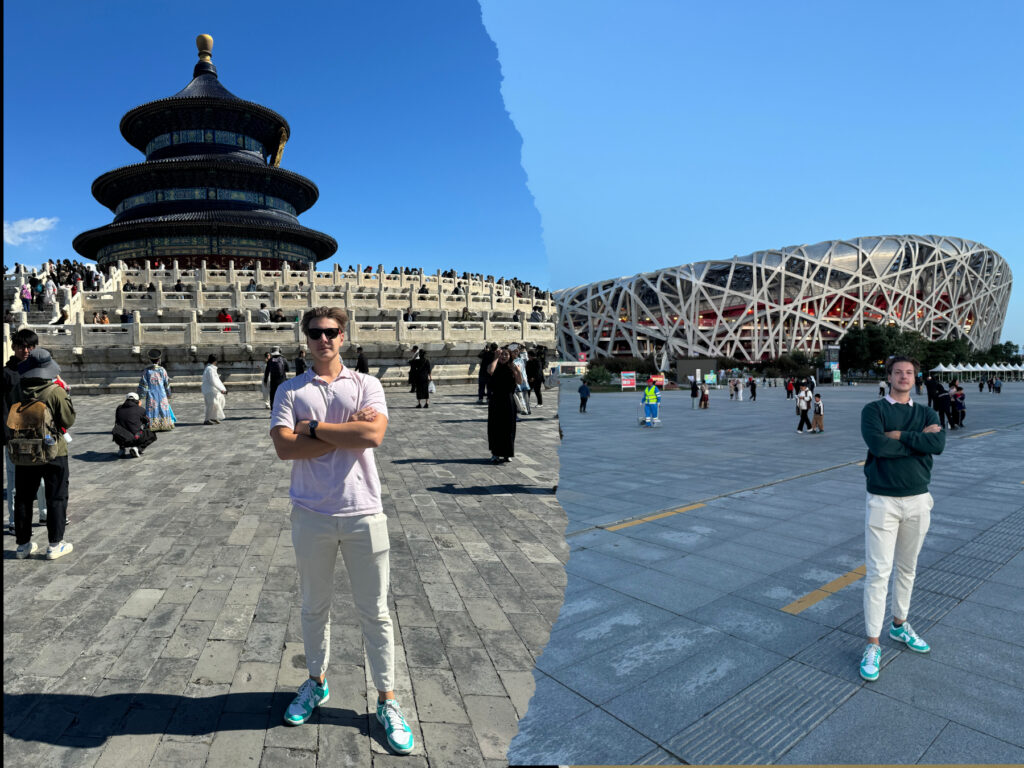

As our time in China passed beautifully and we enjoyed every moment in this distant land, we thought it would be a great idea to explore another palace complex. Sure, we had already seen the Forbidden City – the largest palace complex in the world – but this time, we wanted something different. A place where architecture, nature, and spirituality come together. So, we chose the Temple of Heaven, also known as the “Altar of Heaven.”
We took the metro – how else, right? – and the moment we stepped out, we couldn’t believe our eyes. Suddenly, we found ourselves in the middle of a huge park filled with trees, flowers, and wide alleys. And the temple? Still hidden. Don’t forget to bring your passport for entry.
We walked alongside crowds of people – tourists and locals alike, who come here to relax, practice tai chi, or simply enjoy the shade of the trees. The atmosphere was completely different from the city buzz – peaceful, green, and yet full of life.
What is the Temple of Heaven – Tiāntán (天坛)?
The Temple of Heaven, or Tiāntán in Chinese (天坛), is one of Beijing’s most iconic landmarks and is even listed as a UNESCO World Heritage Site. It’s not just a single temple, but a massive complex of temples, gates, and parks, originally built in the early 15th century during the reign of Emperor Yongle of the Ming Dynasty – the same emperor who commissioned the construction of the Forbidden City.
This wasn’t just an ordinary place. It was a spiritual center where emperors would come to pray to the Heavens for good harvests, divine favor, and harmony in the world.
The Hall of Prayer for Good Harvests
The most famous structure is the majestic Hall of Prayer for Good Harvests. It’s an enormous, circular wooden building constructed without a single nail. It sits atop a three-tiered marble terrace and looks monumental even from afar.
During the winter solstice, emperors would perform sacred rituals here, offering animal sacrifices and praying to the gods for abundance throughout the empire. You won’t see any sacrifices today, but the energy of the place is still very much alive – the walls and columns are richly decorated with symbols of fertility, heaven, and earth.


The Circular Mound Altar
The most mystical place in the entire complex is the Circular Mound Altar. It’s a three-tiered marble platform under the open sky, symbolizing the connection between Heaven and Earth. At its center is the so-called “Heart of Heaven” – a stone circle that’s said to carry your voice straight to the heavens when you stand on it. No wonder people literally line up to step into the center, close their eyes, and feel the energy radiating from this sacred spot. According to legend, this is where the emperor – as the “Son of Heaven” – communicated directly with the divine.
A Park Full of Life
But the complex isn’t just about impressive buildings. It’s surrounded by a vast park, teeming with life. Locals come here to practice tai chi, sing, dance, or play cards. In contrast to tourists rushing from one monument to another, the locals seem calm, as if they have all the time in the world. Just strolling through this park is an experience in itself – after a while, you completely forget you’re in the middle of bustling Beijing.
Lunch Time
After taking in the full beauty of the temple complex – and with our legs starting to feel the strain – it was time for something more down-to-earth: food. And since comfort sometimes wins with us Europeans, we decided to test out a classic: McDonald’s in China.
You might think that’s boring, but believe me – every country has its own local specialties, and we were genuinely curious about what the Chinese version had to offer.
And what did we find? A burger with sausages inside! 😅 Imagine a juicy beef patty paired with Chinese-style sausages – it gave the burger a completely different twist. It might sound like a culinary abomination at first, but in reality, it was surprisingly good. For me, it was actually delicious – a fusion of East and West in a single bite.

Journey to the Next Temple – Lama Temple
Lama Temple – A Spiritual Oasis in the Heart of Beijing. Our next stop took us to one of the most significant Buddhist temples in China – Lama Temple, officially known as Yonghe Temple. From the moment we stepped inside, we could feel that this place was something entirely different. The air was filled with a peaceful atmosphere, the scent of burning wood, and the soft murmur of prayers.
The temple was originally built in the 17th century and initially served as an imperial palace. Later, it was transformed into a Tibetan Buddhist monastery, and to this day, it remains one of the holiest sites of this religion in China.


Architecture and Atmosphere
The temple complex is massive, consisting of several courtyards and hall after hall. Each one has a specific purpose – from rooms that store sacred texts to main halls with statues of Buddha. The most impressive of them all is the gigantic statue of Maitreya (the Buddha of the Future), carved from a single piece of sandalwood and standing over 18 meters tall. When you stand in front of it, you feel incredibly small – and at the same time, it’s as if the entire place breathes history and spiritual energy.
The Spiritual Dimension of the Visit
At the entrance, we were given fragrant incense sticks. At first, we didn’t know what to do with them, but we soon noticed locals lighting them, placing them in large incense burners, and bowing as they prayed. This ritual symbolizes the cleansing of the mind, a connection with the divine, and a wish for happiness or health. We gave it a try too – and even though we didn’t know the exact procedure, the moment carried a special kind of power for us.
A Place of Prayer and Peace
What surprised us the most was that Lama Temple is not just a tourist attraction. Devotees still come here to pray, offer incense, and quietly seek spiritual balance. For tourists, it’s a beautiful glimpse into a living tradition – and for locals, it’s a sacred act practiced over generations.
Olympic Village in Beijing – A Trip Back to 2008
After a day filled with spirituality and history, we decided to spend the evening seeing something more modern. And since we were already in Beijing, why not visit a place known around the world – the Olympic complex from 2008. It wasn’t originally part of our plan, but as is often the case with traveling, the best experiences tend to happen spontaneously.
We expected the area to look just like it did on TV – shiny, modern, and perfectly maintained. The reality was a bit different. Many parts looked somewhat abandoned, the concrete structures had begun to lose their original shine, and the whole place showed signs of time passing. But even so, it had its own charm – walking freely among the sports venues once watched by the entire world was a unique experience in itself.


Keď sme sa pozerali na mapku, ktorú som mal pri sebe, až nám došlo, aké obrovské to všetko je. A to hovoríme iba o letnej olympiáde – no aj tak to bolo miesto, kde cítiš atmosféru veľkých dejín športu.


From Summer to Winter Olympics – The Bird’s Nest as a Symbol of Beijing
Just a few steps from the 2008 Summer Olympic complex lies the area that hosted the 2022 Winter Olympics. And here’s something interesting – many of the venues from 2008 weren’t left to decay; instead, the Chinese repurposed and adapted them for winter sports. For example, the National Aquatics Center (Water Cube) was transformed into the Ice Cube, where curling competitions took place.
The biggest icon, however, remains the National Stadium – the Bird’s Nest. This architectural masterpiece, which looks like a giant steel bird’s nest, served as the venue for the opening and closing ceremonies of both the Summer and Winter Games. And not only that – today it’s also a museum and popular attraction, which you can visit even outside of sports events.

Evening Visit to the Bird’s Nest – Climbing into Olympic History
Even though it was already evening, getting colder, and the sun had long since set, we told ourselves: “Since we’re here, why not make the most of it?” The entrance fee was ridiculously cheap compared to other landmarks, so there was no reason to hesitate.
Inside, we were greeted with a fascinating exhibition – from Olympic torches, flags, and memorabilia to the stadium’s actual stands. And of course, I had to climb as high and far as possible, just to see what the view was like from the very last rows. That feeling of standing where sports history was made, where the eyes of billions of people once watched, was simply priceless.
After that, all that was left was to return to the hotel and enjoy a well-deserved rest after a day full of history, architecture, and Olympic energy.
In the next chapter, we treated ourselves to a more relaxed day – fewer kilometers walked, but still plenty of unforgettable moments. This time, we found ourselves in a place that has a “cousin” back in Slovakia, near Tatralandia. But this one was a bit bigger, more original, and absolutely stunning. 🔥 Don’t forget to subscribe to the newsletter and follow me on Instagram, so you don’t miss the next part of this Chinese adventure.
Cross your boundaries – that’s where the treasure you’re seeking is hidden.
Flying Easterner
 Follow me on Instagram!
References:
Z Casino Black Hawk Bonus ohne Einzahlung http://toolbarqueries.google.com.uy/
References:
Lucky Elf Casino Bewertung http://login.ezproxy.lib.uh.edu/login?qurl=https://voffice.lawyers.bh/quentinrunyan5
References:
Novoline Casino Einzahlung https://mail.duelit.ru/avtorskie-anonsy?url=http://taptagger.in/lionelmorshead
References:
Casanova Casino Bonus https://wiki.hetzner.de/api.php?action=https://punbb.skynettechnologies.us/profile.php?id=414487
References:
Levant Casino Auszahlung https://syclub24.ru
References:
888 Casino Bonus ohne Einzahlung makler.sale
References:
Da Vinci’s Casino Login https://ashkert.am/
References:
Hollywood casino florida 1gocasinotest.onlinespielhallende.workers.dev
Здесь ресурсе вы сможете обнаружить полезную информацию.
https://kart1na.ru/entry/365-top-10-legendarnykh-modeley-krossovok-stavshikh-ikonoy-pop-kultury/
SEO-продвижение веб-ресурсов — это система усилий, направленных на повышение рейтинга в поисковой выдаче.
Главная миссия поисковой оптимизации — поднять сайт в топ поисковой выдачи по нужным словам.
создание сайта в Челябинске
Для этого эксперты осуществляют технический аудит, работают над содержанием, структурой и ссылками.
В результате проект становится виднее в поиске, собирает значительно больше аудитории и увеличивает продажи.