
Another day in Barcelona began with a smile — a full day of architecture, views, and history ahead of me. I knew I’d finally get to see one of Spain’s most iconic landmarks: La Sagrada Família, the tallest church in the world (well… once they finally finish it 😅).
🌀 Antoni Gaudí – The Genius Who Built Dreams from Stone
He was a Catalan architect who completely changed the way people saw architecture. You recognize his style instantly — organic shapes, colorful mosaics, flowing lines, and inspiration drawn straight from nature.
A deeply religious man, Gaudí believed that beauty was a reflection of God’s creation — that’s why his works are full of trees, seashells, honeycombs, and ocean waves turned into stone.
He devoted most of his life to Barcelona, creating masterpieces like Casa Batlló, Casa Milà (La Pedrera), Park Güell, and of course, La Sagrada Família, which he worked on until his death. Sadly, he died after being hit by a tram — but he left behind a legacy that stands among the greatest treasures of world architecture.
Park Güell
So, I set off to explore Park Güell, surrounded by palms, mosaics, and wavy walls that look like something straight out of a dream. The goal was clear — to reach the Turó de les Tres Creus viewpoint, the highest point of the park.
On the map, it didn’t look that far… but the climb definitely got my heart rate up (especially after a breakfast consisting of one croissant and a lot of water 😄).
Turó de les Tres Creus literally means “Hill of the Three Crosses” — a stone hill topped with three large crosses, offering a breathtaking panoramic view of Barcelona and the Mediterranean Sea.
Gaudí originally planned to build a small chapel here, but only the rocky viewpoint was completed — and honestly, it has its own kind of magic. From up there, you can see everything — from the Sagrada Família all the way to the sea. The wind in your hair, tourists all around, and that one thought crossing your mind:
“Yep, this was totally worth it.”


When Enough Is Never Enough
I wanted to go even higher — to see the city from a completely new angle — so I followed the road past Casa Trias all the way to Mirador de Joan Sales. But there I hit the park’s boundary — and since Park Güell has controlled entry, I knew that if I stepped outside, they wouldn’t let me back in. There was even a security guard who basically said: “Nope, not happening.” 😅
So I turned around and slowly made my way back through those twisting, narrow streets that look like they were drawn in a dream (or maybe during one of Gaudí’s more psychedelic moments 😄).
All around me — mosaics, colors, patterns — a full-blown visual firework show. Every single meter begged for a photo, and every few seconds I just found myself saying, “Wow, what even is this?!”
I sat down for a while, just staring — wide-eyed — soaking in that beautiful chaos and wondering how on earth someone could design something like this.
From the park, I headed toward the legendary Sagrada Família, but on the way, I made a stop at one truly fascinating place — Recinte Modernista de Sant Pau. And when I say fascinating, I mean it literally.


🏛️ Recinte Modernista de Sant Pau – The Hospital That Looks Like a Fairytale Palace ✨
Just a few minutes’ walk from the Sagrada Família lies this massive complex of a former hospital — today one of Barcelona’s most beautiful landmarks. Sant Pau was designed by Catalan architect Lluís Domènech i Montaner, one of Gaudí’s contemporaries, and a man with an equally wild imagination.
The entire complex was built between 1902 and 1930 and is now listed as a UNESCO World Heritage Site, recognized as one of the largest and most stunning modernist architectural works in the world.
Imagine a hospital that looks like a colorful palace from a fairytale — richly decorated buildings, domes, ceramic mosaics, fountains, palm trees, and even underground tunnels connecting the different pavilions.
Patients here once stayed in rooms overlooking gardens because the architect believed that beauty helps heal. And honestly? He might have been right. Today, Sant Pau serves as a cultural center and museum, and once you see it, you’ll understand that Barcelona isn’t just Gaudí — it’s an entire gallery of genius minds.
From Recinte Modernista de Sant Pau, a long straight avenue leads directly to the Sagrada Família — my next stop. As I wandered down that street, hunger kicked in, so I decided to grab lunch along the way.
I ended up in a restaurant called Aladin — Spanish sunshine, Arabic vibes, and me ordering a pizza. A mix of cultures so good, UNESCO should probably list it as a symbol of travel. 😄
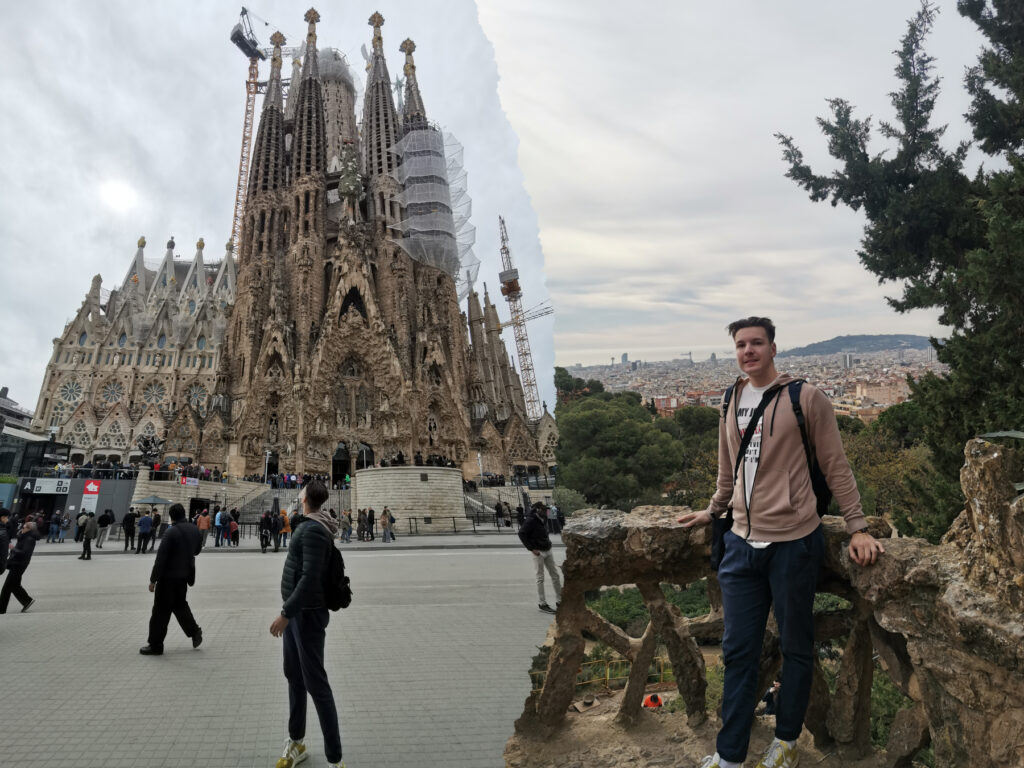
Finally, I reached the Sagrada Família itself — and honestly, I’d never seen anything like it. The church is so enormous you literally have to step back to fit it in one photo — and I still plan to visit the Cologne Cathedral someday! But this? This isn’t just a building — it’s a stone universe, filled with details you could spend hours just trying to understand.


⛪ Sagrada Família – A Church That’s Been Under Construction Longer Than Most Civilizations 😄
The Basílica de la Sagrada Família began construction way back in 1882. A year later, Antoni Gaudí took over the project and completely transformed it — turning what was meant to be a simple Neo-Gothic church into a fantastical masterpiece blending Gothic elements, modernism, and nature-inspired motifs.
Gaudí devoted over 40 years of his life to this project, and when he died in 1926, only one tower had been completed.
The construction moved slowly over the decades, funded entirely by donations and ticket sales. During the Spanish Civil War, some of Gaudí’s original plans were destroyed, but thanks to digital technology and 3D modeling, architects have been able to recreate much of his vision. Today, a team of architects, engineers, and craftsmen from around the world continues his life’s work.
When finished, the basilica will have 18 towers — 12 for the Apostles, 4 for the Evangelists, one for the Virgin Mary, and the tallest one, reaching 172.5 meters, dedicated to Jesus Christ. That will make the Sagrada Família the tallest church in the world. Completion is currently planned for 2026, exactly 100 years after Gaudí’s death.
My favorite view was from the eastern side, where there’s a small pond and park — from there, the basilica looks almost miraculous, especially when its towers reflect perfectly in the water. I walked around it several times, seeing how each side told a different story — the western façade darker and more dramatic with scenes of the Crucifixion, while the eastern façade celebrates the joy of the Nativity.
Eventually, I sat down in the park facing the western side, opened a bottle of water, and just stared. It was one of those rare travel moments when you think to yourself: “This moment will never happen again.”


Keep Moving
But I wasn’t done yet — my plan for the day was to see a whole lot more of Barcelona’s landmarks, so I got back into explorer mode. From the Sagrada Família, I made my way toward Passeig de Gràcia, where two of Gaudí’s most famous buildings stand — Casa Milà and Casa Batlló.
🏠 Casa Milà – La Pedrera, the Stone Dream
Casa Milà, better known by its nickname La Pedrera (meaning “The Stone Quarry”), was built between 1906 and 1912for wealthy businessman Pere Milà. Here, Gaudí truly let his imagination run wild — the building has no straight lines at all. Everything waves, curves, and flows, and even the balconies look like they’re melting in the sun.
Ceilings, walls, doors — everything is interconnected, inspired by nature, water, and wind. On the rooftop, you’ll find the famous chimneys shaped like soldiers, now one of Barcelona’s most iconic sights.
It’s more than just a house — it’s a work of art that proves Gaudí wasn’t only chasing beauty; he was designing function through fantasy.

🐉 Casa Batlló – The House That Breathes Fantasy
Just a few meters further stands another of Gaudí’s masterpieces — Casa Batlló, built for textile magnate Josep Batlló. This building is pure imagination — a colorful façade made of ceramic mosaics, skull-shaped windows, wavy walls, and a roof that looks like the back of a dragon.
Legend has it that Gaudí was inspired by the tale of Saint George, the patron saint of Catalonia, who slayed the dragon — the roof represents the dragon’s back, while the tower topped with a cross symbolizes the saint’s spear.
Inside, every single detail is thought through — light, curves, shades of blue. Even a simple staircase railing looks like a piece of sculpture. I’ve seen plenty of unusual buildings in my travels, but this one… this one feels like it’s from another dimension.

After Gaudí’s “art marathon,” I headed toward the old city center, not far from the famous La Rambla street, where the Basilica of Santa Maria del Pi stands. It’s a beautiful Gothic church from the 14th century, built from dark stone, with a tall bell tower rising above the historic quarter.
The interior is simple, yet the atmosphere is powerful — huge stained-glass windows, wooden pews, and a silence that feels like a peaceful contrast to the noisy streets outside. As for La Rambla itself… well, let’s just say it didn’t really impress me that much.

Barcelona Cathedral
Just a few minutes later, I found myself standing in front of the Cathedral of Barcelona — officially the Catedral de la Santa Creu i Santa Eulàlia, dedicated to Saint Eulàlia, the city’s patron saint. From the outside, it’s monumental — classic Gothic towers, countless details, and a presence that dominates the old quarter.
Inside, it’s even more impressive — towering columns, a grand altar, a choir echoing through the nave, and a courtyard filled with palm trees and geese, which symbolize Saint Eulàlia herself.
I bought a ticket for €14, which included access to the interior and the rooftop terrace — and the view over the entire city was absolutely worth it. But I have to admit — I noticed something about Barcelona:
you pay for literally everything. Even for “a glimpse of heaven through stained glass.” 😅 Still, Barcelona does tourism in style — if you’re gonna charge, at least do it grandly.
And one more thing made me laugh up on the rooftop — there was an actual old latrine! Yep, just in case someone centuries ago got “inspired” by the view a little too much, history had them covered. 😄 It was probably used back when the cathedral served not only as a church but also as a place of refuge during battles.


Bombed Barcelona
I’d heard that Barcelona was heavily bombed during the Spanish Civil War, and apparently, you can still see traces of those attacks near the Jaume I metro station, right next to the cathedral. So, of course, I decided to check it out for myself.
I went down into the metro, but honestly… I didn’t see anything special. The station looked completely normal — just a few surface repairs going on. Later, I found out that the real scars from the 1938 bombings can actually be seen at the nearby Plaça de Sant Felip Neri, only a few minutes from the station. There, you can still spot bullet holes and blast marks on the church walls.
So if you’re ever in Barcelona — I’d totally recommend stopping by. It’s a quiet, powerful place, a stark contrast to the city’s usual noise and chaos. I personally missed it that day, but it’s one of those hidden corners with a heavy story behind it.
At that moment, though, I found myself on a different little square, desperately looking for shade and, most importantly, water — I was as thirsty as if I’d just run a marathon. And that’s when one of my favorite travel scenarios happened: pure coincidence led me somewhere I never planned to go.
Out of nowhere, I spotted a bar called Dunne’s Irish Pub — a classic Irish-style spot right in the middle of Barcelona. I thought, “Why not?” So I walked in, ordered a Guinness (apparently, I hadn’t fully left Ireland behind 😄), and behind the bar stood a Croatian bartender.
We started chatting, hit it off right away, and he even gave me a tip about a place that was actually on my list — though I didn’t know much about it yet. He said, “You should definitely go — it’s worth it.”
And he was right. Where I went next and what I found there — you’ll find out in the next part.


In Barcelona Without Seeing the Sea? No Way!
After a pint at the pub and a short rest, I decided to take a walk down to the sea. From the city center, I wandered through the marina, where yachts were docked — though honestly, they looked more like floating hotels than boats. Each one probably cost more than my entire life so far, but I told myself,
“One day — for tax optimization purposes, of course — I’ll get one too.”
A few minutes later, I found myself standing on Sant Miquel Beach, one of Barcelona’s best-known beaches. It’s just a few steps from Barceloneta, so you literally walk out of the narrow city streets and suddenly — boom — you’re facing sand, sea, and palm trees.
The beach is named after the nearby Sant Miquel del Port Church and is one of the oldest urban beaches in Barcelona. In summer, it’s buzzing — surfers, beach bars, volleyball, music — but when I was there, it was chilly, so swimming wasn’t exactly on the table.
Still, the place had its charm. As the sun began to set, the sea glowed orange, the wind carried that salty scent, and the beach was full of incredible sand sculptures that took my breath away. These weren’t your average sandcastles — we’re talking dragons, human figures, even a dragon breathing fire, looking as if it might come alive any second.
The artists who make them truly turn sand into art — the kind that makes you want to drop them a few coins just to say “thanks for making the beach magical.”
When night finally fell, hunger kicked in — and as in every country, I had to perform my ritual McDonald’s test. Not for the haute cuisine, of course, but pure curiosity — “how do they do it here?” I went for a McExtreme menu with a double burger, fries, and ice cream — the classic combo that never disappoints.


It was getting late, so I headed back to my accommodation — another long day was waiting for me, and I didn’t want to miss a thing. Barcelona had already given me a huge boost of energy, but the best was yet to come. If you don’t want to miss the next part of my Spain adventure, make sure to follow me on Instagram and subscribe to the newsletter, so you’ll be there when new stories unfold!
Cross your boundaries – that’s where the treasure you’re seeking is hidden.
Flying Easterner
 Follow me on Instagram!