
I had everything figured out. I didn’t want to spend too much time in one place, so I decided to keep going with my “quick, intense, no stopping, we’re already late” travel plan. This time, I set my sights on the town of Mijas. Why there? You’ll find out today.
My Spanish adventure continued — after Barcelona and Sitges, I headed further south. The previous night, as you might remember from the last chapter (you can find it HERE), I ended the day with a Guinness in hand at an Irish pub, then went straight to sleep because an early flight was waiting for me.
Flight to Málaga
I flew early in the morning to Málaga, so I’d have the entire day ahead of me. And that was exactly the plan — land, step out of the airport, and dive right back into a tempo that would challenge even a marathon runner.
After about an hour in the air, we touched down in Málaga, and my goal was clear: get to the town of Mijas.


Why Mijas?
You might be wondering why I decided to visit a town I had literally never heard of before. The answer is simple — Mijas is one of those classic white Andalusian towns, where every house is painted bright, snow-white.
It’s the kind of place that looks like a postcard scene, a completely different world compared to Barcelona, Sitges, or Málaga. And that’s exactly what I wanted — contrast, something new, and an atmosphere you won’t find anywhere else.
Getting from Málaga to Mijas
First, I needed to get to the bus stop where the Mijas-bound buses depart. Google Maps gave me the exact route, so the plan was clear — from Málaga Airport, walk to the stop Villarosa, and from there take bus M-113.
And of course, I walked. Because why not? Morning warm-up included. I was supposed to transfer from the M-113 in Fuengirola, but just to be safe (and mainly because the display inside the bus told me to), I switched earlier at the stop Seat Bellamar V.
There I hopped onto bus M-122, which took me all the way to the final stop in Mijas Pueblo.
A Classic “Me Story”: Bus, Payment, and a Banknote Problem
But… it wouldn’t be me if something didn’t go wrong. The bus fare was about €3, but of course I only had a €50 note. No card payments, the driver had no change, and I could already feel that familiar “oh no, I’m about to cause a mini-chaos” moment.
And then — the hero of the day appeared. A lady sitting in the front told me she would tap me in on her transport card. Turns out they use a special transport card system in Málaga with discounted fares, so it charged her only around €0.80 for my ride.
Absolute legend — otherwise, I’d probably still be standing there today.
Arrival in Mijas
The whole journey took over an hour, transfers included. When I finally got off, it was around 11 a.m., and it looked like rain was about to start any minute — clouds hanging low like retirees over their pensions.
Still, I kept walking, and soon I reached the narrow traditional streets that Mijas is famous for. White buildings, flower pots on the walls, balconies with wrought-iron railings… it all felt like a movie scene. Nothing exaggerated, nothing modern — just pure, authentic Andalusian atmosphere that hits you the second you see it.
It was absolutely stunning — exactly the kind of place people travel for.


The Hike to the Cantera del Barrio Viewpoint
First, I needed a proper view of the whole town. Since Mijas sits up in the hills, I knew there had to be some spot with a postcard-perfect Andalusian panorama. I found a place on the map called Cantera del Barrio — an abandoned quarry that’s now used as an unofficial viewpoint.
There is a gate there, but it’s not locked, so you can simply walk around it… no problemos.
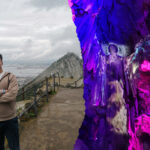
The climb takes about 30 minutes — pretty easy, though of course you’re walking uphill. And at the top? You get a beautiful panoramic view of the entire white town of Mijas, its houses glued to the hillsides, and in the distance you can even see Fuengirola and the coastline of the Costa del Sol.
Exactly the kind of moment when you tell yourself it was worth sweating through three layers of clothing.


Interesting Facts About Mijas
Mijas is one of the most famous “pueblos blancos” — the white villages of Andalusia.
Every house has to follow traditional rules:
– white walls
– blue or colorful flower pots
– narrow streets
– preserved architecture
More fun facts:
Mijas is divided into three areas:
– Mijas Pueblo
– Las Lagunas
– Mijas Costa along the shoreline
Historically, it’s a former Roman and Arab settlement, which you can still see in the shape of its streets and layout.
It’s also known for the old “burro taxis” — donkey rides that once carried tourists. Today, this tradition is heavily limited. And most importantly: Mijas is loved for its peace, views, and beautiful atmosphere, not big-city bustle. It’s the perfect place for relaxing walks and photos.
Lunch at Plaza de la Constitución
When lunchtime came, I headed back into town. My eyes landed on Plaza de la Constitución, a small square with a fountain, palm trees, and lovely views down the streets. That’s where I chose the restaurant Confusión, and I treated myself to a proper lunch — a beer and salmon with fries as the main dish.
Honestly? The best decision I could’ve made. Simple, quality food that brings you back to life after a climb to the viewpoint.
And after a good lunch, of course, there has to be ice cream.
Because if there isn’t time for gelato in the Andalusian hills… then where is?

Visiting the Bullring — Plaza de Toros de Mijas
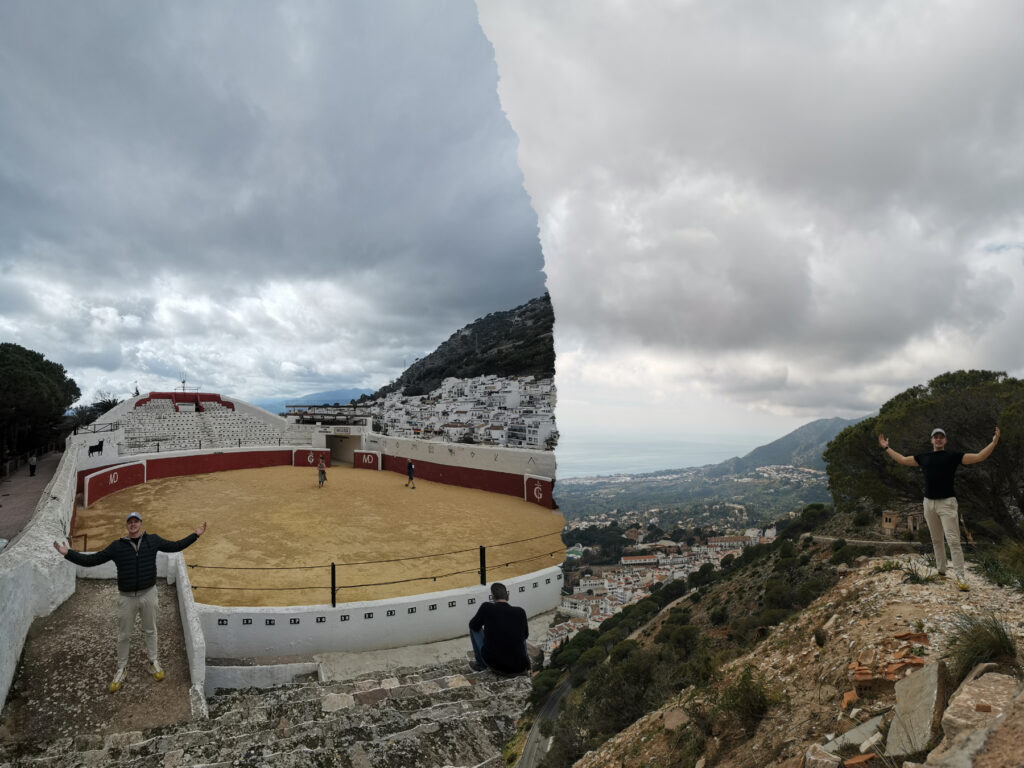
Then I headed toward the town center, where you’ll find the Plaza de Toros de Mijas — one of the most unique bullrings in all of Spain.
And why is it unique?
- It was built in 1900.
- It has an oval shape, which is extremely unusual (most bullrings are perfectly circular).
- It’s one of the smallest bullrings in Andalusia.
From the outside, it looks like a simple white building, but inside it’s like a mini version of the famous arenas in Madrid or Seville.
Even though bullfights are almost no longer held today, the arena is open as a historical landmark and offers beautiful views of the surrounding area. It’s also one of those buildings that really completes the atmosphere of a traditional white Andalusian town.


Okruh okolo centra a Mirador del Paseo de la Muralla
Hneď oproti býčej aréne sa nachádza Iglesia Inmaculada Concepción, kostol z 16. storočia postavený na základoch bývalej arabskej mešity. Pozrel som sa dnu, ale úprimne – až tak ma neoslovil. Tak som pokračoval ďalej na menší okruh, ktorý vedie okolo arény, kostola a miestneho amfiteátra, až k vyhliadke Mirador del Paseo de la Muralla.
Odtiaľ sú fakt krásne fotky:
– celé mesto pod tebou,
– biele domčeky ako lego,
– rokliny a útesy, ktoré sa zarezávajú do krajiny,
– a výhľady, pri ktorých rozmýšľaš, či si ešte v Európe alebo niekde v Maroku.
Je to perfektné miesto na chill, fotenie aj krátke sedenie na lavičke s pocitom, že život má zrazu pomalší rytmus.


Mijas Wagon – a Miniature World in Glass Cases
On my way back, I came across Mijas Wagon, a small museum of miniatures. From the outside it looks totally unremarkable, but inside? A complete mind-blow.
What can you find there?
- the smallest Bible in the world,
- paintings made on a single grain of rice,
- artistic scenes sculpted into the head of a pin,
- microscopic tools, animals, and objects,
- models you can only see through a magnifying glass or special optical lenses.
In short: A world you can only look at with one eye, but you’ll stand there longer than in some “normal” museums. A tiny version of the world that even Ant-Man would appreciate.


Return to Málaga & Solving the Logistics
As the day was coming to an end, I slowly made my way to the bus that was supposed to take me back to Málaga. The transfer in Fuengirola was quick, and honestly — I wouldn’t have caught it if I hadn’t gotten off exactly at the right pole-stop.
Another important thing: in Mijas, bus tickets are bought at the station, not from the driver. So I had to sort that out beforehand, because if I left it to chance, with my luck I’d probably end up walking along the highway to Málaga.
In the end, everything worked out, and I rode back to Málaga’s city center. From there, I headed to the main station, where I needed to figure out which platform my 6:00 a.m. bus for the next destination would depart from. I didn’t want any morning panic, so I went to check it the night before.

Evening in Málaga & Accommodation
Once everything was sorted out, I treated myself to a kebab, because after a whole day of moving around, my stomach was already playing Spanish castanets. Then I headed to my Airbnb — a room in an apartment owned by a very kind lady. Everything went smoothly, and I just crashed into bed to recharge for the next day.
And where did I go next? You’ll find out in the next chapter. Don’t forget to follow me on Instagram and subscribe to the newsletter so you don’t miss anything!
Cross your boundaries – that’s where the treasure you’re seeking is hidden.
Flying Easterner
 Follow me on Instagram!