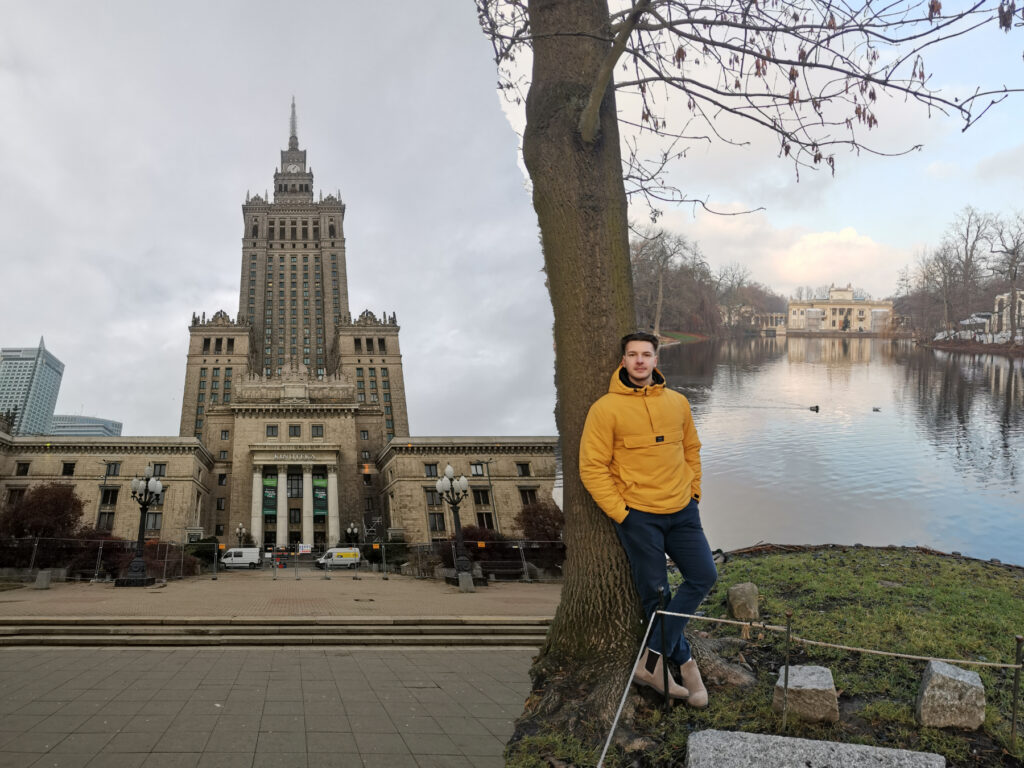

This trip came together a bit spontaneously. Warsaw. I already had plans to head off to another country for a longer stay in a few weeks, but in the meantime, an opportunity popped up to join my dad on a business trip to Warsaw. We figured—why not turn it into a quick getaway? Basically 24 hours in the city, split across two days.
On the first day, we took care of all the business stuff, and in the evening, we went for dinner at Galeria Wileńska, a shopping center close to our Hotel Hit. I had classic Polish pierogi and a bit of meat—let me tell you, Warsaw pierogi just hit differently compared to the hearty Slovak ones.
Day two was packed to the brim. Having just one day to explore Warsaw is definitely a challenge, but with the right plan, you can actually fit in quite a lot. And that’s exactly what this post is about—everything you can experience in Warsaw in just 24 hours.

Morning stroll and first stops in Warsaw
We woke up, had some hotel breakfast—nothing fancy, but the usual eggs and sausages did the job. The plan was simple: cover as much ground on foot as we could before heading deeper into the city.
Our first stop was the Cathedral of St. Michael the Archangel and St. Florian the Martyr (in Polish: Parafia Katedralna pw. Św. Michała Archanioła i Św. Floriana Męczennika—yeah, quite the mouthful 😅). This neo-Gothic church from the late 19th century is one of the main landmarks in Warsaw’s Praga district.
What’s interesting is that it was heavily damaged during WWII but later rebuilt by the Polish people as a symbol of resilience and faith. Today, it stands tall with two massive towers you can spot from far away—making it a clear point of reference in the area.
Just a few steps from the cathedral—maybe 50 meters—we stumbled upon something that made us smile. There was the Monument to the Praga Courtyard Band—a quirky set of statues honoring the tradition of local street bands typical for this working-class neighborhood. It felt like a warm tribute to Warsaw’s music scene, and the vibe around the monument made it seem as if the musicians had just taken a quick break from playing.


Metro and the ride to the National Stadium
Our first metro ride in Warsaw was an experience on its own. We decided to buy a 24-hour travel pass the night before, just to keep things simple and avoid worrying about tickets every time we hopped on public transport. The cost? Around 15 PLN (roughly €3.50)—and it’s valid for all types of public transport in the city: metro, buses, and trams.
Warsaw’s metro might not be as massive as the one in London or Beijing, but it’s still super practical. There are just two lines—red and blue—that intersect in the city center, making it easy to reach all the major landmarks comfortably.

We got off at the National Stadium (Stadion Narodowy), one of the largest and most modern constructions in Poland. It was opened in 2012 for the UEFA European Football Championship and has since become a symbol of modern Warsaw. The stadium can hold over 58,000 spectators, and its red-white-grey façade is designed to resemble a waving Polish flag. Besides football matches, the stadium also hosts huge concerts, exhibitions, and various sports events—from speed skating to motor shows.
The Warsaw National Stadium has a capacity of around 58,500 people, making it the largest stadium in Poland. It’s even witnessed legendary music events—like the Metallica concert, which gathered over 65,000 fans (yes, even more than its official capacity).
The atmosphere was said to be electric: a massive crowd, music shaking the entire city, and the stadium literally vibrating with energy. The best part? You can visit it through guided tours that take you not only into the stands but also into the locker rooms, player tunnels, and VIP areas.


Warsaw’s Green Oasis – Łazienki Królewskie Park
After the sporty vibes of the stadium, we decided to slow down the tempo and headed to Łazienki Królewskie, the largest and most beautiful park in Warsaw. This royal complex is full of palaces, pavilions, and statues, and a walk through it truly feels like stepping into another world.
Our first stop was the Frederic Chopin Monument – a monumental statue of the famous Polish composer, standing in the middle of a stunning garden. The charm of this place is even stronger during summer when live Chopin concerts often take place right here. Even though it was quiet during our visit, we could almost hear his melodies in our heads. The atmosphere felt nothing short of magical.
Just a few steps away is the Belweder Palace, another icon of Polish history. This neoclassical palace served for years as the residence of Polish presidents and is still used for state functions and ceremonial events today. It looks very elegant – and when you’re standing in front of it, you can sense the weight of Polish history that has passed through its doors.
I highly recommend walking through the entire park, all the way to the bridge with the statue of Neptune. From there, you get a beautiful view of the amphitheater and the Łazienki Palace itself. Along the way, we stopped by the Royal Łazienki Theatre and the Old Orangery – which is a piece of art in itself and now houses an exhibition of ancient sculptures. A bit further, you’ll find the White Pavilion, which honestly looks like a smaller version of the White House in the US.
Eventually, we reached the Łazienki Palace itself, which once served as the summer residence of Polish King Stanisław II Augustus. The palace is built right on the water – hence the nickname “Palace on the Isle” – and its reflection in the lake gives it a floating appearance. Peacocks roam freely around the area, adding to the atmosphere and making it feel like a scene from a historical film.


City Center
After everything we had seen in the park, we decided to head to the city center. And there – a completely different world. Skyscrapers, shopping malls, the hustle and bustle of a big city. Warsaw is often nicknamed the “New York of Europe.” But the true dominant feature of the skyline is the Palace of Culture and Science (Pałac Kultury i Nauki) – a massive building in the style of socialist realism, gifted to Poland by the Soviet Union in the 1950s.
The building stands over 237 meters tall, has 42 floors, and remains the tallest building in Poland. We took the elevator up to the viewing terrace, and the panoramic view was stunning – skyscrapers, the old town, and Warsaw’s sprawling city streets all laid out before us.
The Palace of Culture and Science
This towering giant – 237 meters tall with 42 floors – was built between 1952 and 1955 as a “gift” from the Soviet Union. For many Poles, the building is a symbol of a conflicted past – on one hand, an architectural masterpiece of socialist realism, and on the other, a stark reminder of Soviet domination. Because of that, it’s often jokingly referred to as “Stalin’s gift” or simply “The Gate to Hell.”
Today, the building houses a mix of offices, museums, theaters, and even a cinema. The biggest highlight, however, is the observation deck on the 30th floor, offering breathtaking panoramic views over the whole of Warsaw.

The Warsaw Uprising
Next, we moved on to something that truly gave us goosebumps – the Museum of the Warsaw Uprising (Muzeum Powstania Warszawskiego). To understand the impact: in August 1944, an uprising broke out in the city against the Nazi occupiers. It was meant to last just a few days, but stretched on for 63 days.
Around 50,000 fighters – soldiers of the Home Army (Armia Krajowa) and civilians – joined the battle. But the result was tragic: the Nazis crushed the uprising with brutal force, killing more than 150,000 Warsaw residents and nearly leveling the entire city.
The museum, which opened in 2004, is both modern and deeply immersive. You won’t just find display cases with artifacts – instead, you’re surrounded by multimedia exhibits, including videos, photographs, personal diaries, and real weapons. One of the most powerful moments comes in a small cinema room, where they show the original Nazi-made film “The Destruction of Warsaw” – documenting how the city was almost entirely erased from the map. Watching it will leave a lasting impression.
There’s also a recreation of the underground sewer system used by the resistance fighters to escape German forces, as well as a memorial wall listing the names of all the fallen. The atmosphere here is so intense, you almost feel as if you’ve been transported back to 1944.


Evening in Warsaw
In the evening, we took another walk through the city center, where we stumbled upon Christmas markets. Stalls, twinkling lights, warm drinks, and the classics – sausages and gingerbread. The whole city sparkled with festive decorations, and there were even these funny talking figurines – when you pressed a button, they’d start talking or singing. It totally cracked us up and added that perfect pre-Christmas vibe.
Of course, there was also the giant “Warszawa” sign, where every tourist lined up to take a photo.
Warsaw’s Rebirth and Jan Zachwatowicz
We didn’t make it to the Copernicus Science Centre in the end, but we did explore the very heart of Warsaw – a city center that’s truly unique. After being completely leveled during World War II, it was later rebuilt from scratch. The person most responsible for this remarkable restoration was architect Jan Zachwatowicz – head of the postwar reconstruction team who led the efforts to restore the Old Town.
Thanks to him, Warsaw’s historic monuments were brought back to life using old paintings, architectural plans, and even the detailed works of Italian painter Bernardo Bellotto (also known as Canaletto). It’s because of this titanic effort that Warsaw’s Old Town is now a UNESCO World Heritage Site.
We also passed by the Presidential Palace, and then headed straight to the heart of the Old Town. There we found the Royal Castle in Warsaw – once the residence of Polish kings. It too was completely destroyed during the war and has since been faithfully reconstructed. Even though it was already dark, we still soaked in the view of the courtyard and parts of the interiors.
Of course, we didn’t forget the spiritual side of things – we visited the St. John the Baptist Basilica and the nearby Academic St. Anna Church. Both buildings breathe history and added a special feeling to the evening – like stepping back in time to a city that had once been lost, and is now beautifully rediscovered.


Warsaw – Christmas Markets
Of course, the Christmas markets were an essential part of our visit. Stalls full of sausages, mulled wine, sweet treats – and to top it all off, a gentle layer of snow that turned the whole place into a real-life winter postcard. As a bonus, there was even the famous statue of the mermaid – the symbol of Warsaw. For the Polish, she holds a similar meaning as the one in Copenhagen does for the Danes, though she has her own legend and mythology.
Right in the middle of the square, people were even ice skating, which gave the entire scene a magical feel.
To wrap things up, we stumbled upon a statue of the man responsible for bringing the Old Town back to life – none other than architect Jan Zachwatowicz. I couldn’t resist snapping a photo with it. Without him, Warsaw would look completely different today.
And just like that, my quick trip to Warsaw came to an end. In the next part of the blog, we’ll head to a completely different country – one where I even moved to and still live today. So don’t forget to subscribe to the newsletter and follow me on Instagram, so you don’t miss the next chapter of Flying Easterner.
Cross your boundaries – that’s where the treasure you’re seeking is hidden.
Flying Easterner
 Follow me on Instagram!

References:
Legiano Casino Kritik https://37.cholteth.com
References:
Leggiano Casino http://www.morrowind.ru/redirect/tzu.to/dhSqG
References:
Legiano Casino No Deposit Bonus https://mcpedl.com/leaving/?url=https://mssq.me/yaniraande&cookie_check=1https://abouttexasholdempoker.blogspot.com
References:
Legiano Casino Spielautomaten http://staroetv.su/
References:
Legiano Casino Cashback http://akmrko.ru/
References:
Legiano Casino Bewertung https://tulum.ru/
References:
Legiano Casino Login https://www.gaiaonline.com/
References:
KingMaker Casino Einzahlung per Trustly https://tiklagit.net/homerberube966
References:
Kingmaker casino banküberweisung einzahlen https://heres.link/
References:
Kingmaker Casino Bonus ohne Einzahlung heres.link
References:
KingMaker Casino Einzahlung Spielgeld https://spd.link/
References:
KingMaker Casino Einzahlung mit Bitcoin https://delta.astroempires.com/
References:
KingMaker einzahlung verdoppeln http://terrano-club.ru
References:
KingMaker Casino App Download runigma.com.ua
References:
Kingmaker casino einzahlungsbonus code 2026 http://3.reddotcr.cafe24.com
References:
KingMaker Casino Sofort Einzahlung https://me23.ru/proxy.php?link=https://upangmarga.go.id/charliecastle
References:
Legiano Casino Erfahrungen https://freesexcamca.chaturbate.com/external_link/?url=http://warblog.hys.cz/user/versetoast59/
References:
Legiano Casino Spielen http://www.google.com.qa/url?q=https://boardgameswiki.site/wiki/Legiano_Casino_im_Test_Fakten_fr_echte_Spieler_2026
References:
Legiano Casino Web App k-texnik.ru
References:
Kingmaker Casino Promo Code maps.google.de
References:
Legiano Casino Support https://slidesgo.com/editor/external-link?target=https://materialwiki.site/wiki/Leguano_Aktiv_Plus_in_MecklenburgVorpommern
References:
Legiano Casino Mindesteinzahlung toolbarqueries.google.com.uy
References:
KingMaker einzahlung gebühren https://calendly.com/
References:
KingMaker paypal einzahlung http://www.dsl.sk
References:
KingMaker einzahlung sofortüberweisung http://clients1.google.co.ck
References:
Kingmaker casino bankeinzahlung http://www.proplay.ru/redirect/qr.dsd.edu.gh/georgiablancha
References:
Legiano Casino Alternative images.google.ie
References:
KingMaker Casino Gutschein einlösen http://wiki.integral.ru/api.php?action=https://unim.ma/shereedrost57
References:
Legiano Casino Live Casino http://www.rufox.com
References:
Hitnspin casino bonus ohne einzahlung http://clients1.google.cv/
References:
Monro Casino Review fxsklad.ru
References:
Hit’n’spin casino erfahrungen http://1–shop5.irisccc.cafe24.com/member/login.html?noMemberOrder&returnUrl=https://beamng.com/proxy.php?link=https://de.trustpilot.com/review/der-wikinger-shop.de
References:
Hitnspin casino images.google.co.ao
References:
Hitnspin casino registrierung https://www.samovar-forum.ru/go?http://cr.naver.com/redirect-notification?u=http://de.trustpilot.com/review/der-wikinger-shop.de
References:
Hitnspin bonus ohne einzahlung cse.google.ac
References:
Hitnspin casino legal https://volos-volos.ru/proxy.php?link=https://www.altamira.edu.ec/profile/dalllbfbell55667/profile
References:
Hit n spin login https://www.freecam8.com
References:
Hit n spin casino 25 euro code flashback.org
References:
Hitnspin casino mobile http://translate.itsc.cuhk.edu.hk/gb/www.divinagracia.edu.ec/profile/deckerzzcrosendahl31825/profile
References:
Hitnspin casino seriös gitlab.com
References:
Hitnspin casino app android https://www.kxdw.com/
References:
Hitnspin casino login politicalforum.com
References:
Hitnspin casino https://pdaf.awi.de/trac/search?q=https://searl.co/richellesears7
References:
Lollybet Casino Erfahrungen aozhuanyun.com
References:
Lollybet Casino No Deposit cse.google.com.ly
References:
Lollybet Umsatzbedingungen archive.kyivcity.gov.ua
References:
Lollybet Casino Bonus Code rtraveler.ru
References:
Lollybet Casino Einzahlung http://images.google.mu/
References:
Lollybet Slots http://omga.su/
References:
Lollybet Casino Bewertung http://www.google.com.qa/url?q=http://www.ensembl.org/Help/Permalink?url=https://lollybet.com.de/
References:
Lollybet Freispiele bing.com
References:
Lollybet Casino Neukundenbonus https://li558-193.members.linode.com/
References:
Lollybet Kontakt acronyms.thefreedictionary.com
References:
Lollybet Casino Login http://cse.google.com.bd/url?sa=i&url=http://concretewiki.site/wiki/Drvinyl_de_Online_Casinos_Deutschland_789_Reguliert_2024
References:
Lollybet Casino Erfahrungen http://aktsh.ru
References:
Hitnspin casino kostenlos spielen http://clients1.google.ms/url?q=http://tropicana.maxlv.ru/user/fenderplant22/
References:
Hitnspin casino einzahlung clients1.google.com.tw
References:
Hitnspin casino app android http://anketki.ru/
References:
Hitnspin casino betrug http://ar.thefreedictionary.com/_/cite.aspx?url=https://wptavern.com/author/iranbra9/&word=حَلِمَ&sources=kdict
References:
Hit n spin casino http://acronyms.thefreedictionary.com
References:
Hitnspin kundensupport es.thefreedictionary.com
References:
Hit n spin bewertung http://lginis.yoo7.com
References:
Hit n spin bonus ohne einzahlung cse.google.cm
References:
Hit’n spin casino http://clients1.google.co.zm/
References:
Hitnspin casino freispiele cse.google.com.fj
References:
Online pokies with payid inmessage.site
References:
Best instant payid pokies australia real money https://gitlab.rails365.net/
References:
Online pokies australia payid real money https://zenithgrs.com
References:
Online payid pokies https://www.atlantistechnical.com/employer/the-most-lucrative-payid-online-pokies-in-australia-in-2025/
References:
Australian online pokies payid superocho.org
References:
Payid online pokies australia https://www.mobidesign.us
References:
Online pokies with payid australia real money dating.vi-lab.eu
References:
New payid pokies sportjobs.gr
References:
Lollybet Casino Verifizierung https://www.google.ms/
References:
Lollybet Casino No Deposit Bonus http://web.school2100.com/
References:
Lollybet Casino Login https://alumni.unl.edu.ec/directorio/verexalumno/zKKAVnF130JBEcuTD9Cgk0wy0zxkTqLICMr6ekLlTkI/4817/1/aHR0cHM6Ly9saW5rLm1vdW1hc2l3ZWIuY29tL2hlbGVuYWhhbWxldHQ4
References:
Lollybet Casino Live Chat images.google.com.tj
References:
Lollybet Casino Erfahrungen http://www.specmashservice.com
References:
Lollybet legal https://winehq.org.ru/
References:
Lollybet Casino No Deposit https://www.chaturbatecams.com/external_link/?url=https://tzu.to/sInQl
References:
Lollybet Casino Seriös image.google.je
References:
Lollybet Casino Live Casino http://cse.google.ca/url?q=https://croys.top/numbers88b5249
References:
Lollybet Casino Bonus ohne Umsatzbedingungen https://www.comic-rocket.com/go?uri=https://jagoan-hosting.online/celsanutter241
References:
Lollybet Casino No Deposit Bonus http://toolbarqueries.google.co.uz/url?sa=t&url=https://links.vann.ca/janniemanor947
References:
Lollybet Casino Roulette google.co.ve
References:
Lollybet Casino DE anahit.fr
References:
Lollybet Einzahlung clients1.google.com.ph
References:
Lollybet Casino Auszahlungsdauer http://maps.google.mn/
References:
Lollybet Umsatzbedingungen http://mebel59r.ru/bitrix/redirect.php?goto=https://getshort.in/dinomerewether
References:
Lollybet VIP www23.ownskin.com
References:
Lollybet Casino Kundenservice https://eda.europa.eu/aa88ee3c-d13d-4751-ba3f-7538ecc6b2ca?sf=96652273A74Ahttps://gabung.link/kathiefrazer69
References:
Lollybet Deutschland images.google.ru
References:
Lollybet Casino Gutschein http://www.google.com.tn/url?q=https://linkee.click/davelundstrom
References:
Lollybet Anmeldung http://images.google.co.mz/
References:
Lollybet Deutschland digitalcollections.clemson.edu
References:
Lollybet Gutschein https://maps.google.com.sg
References:
Lollybet Casino mit Echtgeld http://www.google.al
References:
Lollybet Casino Gutscheincode http://forum.russ-artel.ru/proxy.php?link=https://bmp.pw/emilysouthern1
References:
Lollybet Einzahlung cse.google.sk
References:
Lollybet Casino Login https://avtomir365.ru/bitrix/redirect.php?event1=&event2=&event3=&goto=https://io.321.it/aida58e440
References:
Lollybet Support http://www.h3c.com
References:
Lollybet Casino Gutscheincode http://maps.google.pl/url?q=https://joiboy.ink/pearlinewearne
References:
Lollybet Casino Kundenservice link.zhihu.com
References:
Lollybet Casino Neukundenbonus cse.google.com.bh
References:
Lollybet Bonus Code http://images.google.com.gi/url?q=https://short.thejat.in/leonorabarca7
References:
Lollybet Casino Betrug http://www.google.com.pe/url?sa=t&url=https://fhoz.shop/elidapuckett7
References:
Lollybet Casino mit Echtgeld yandex.com.am
References:
Ipad online https://www.new.jesusaction.org/bbs/board.php?bo_table=free&wr_id=3751249
References:
Online roulette australia https://jobcopae.com/employer/sms-casino-einzahlung-deutschland-2025-per-handyrechnung-bezahlen/
References:
Best online games https://www.kfz-eske.de/instant-casino-sportwetten-gl%C3%BCcksspiel-bewertung-2026
References:
Gamehouse casino https://staffsagye.com/bbs/board.php?bo_table=free&wr_id=112824
References:
New york new york casino las vegas https://punbb.skynettechnologies.us/profile.php?id=341285
References:
Century casino cripple creek https://kds.ne.kr/bbs/board.php?bo_table=free&wr_id=129953
References:
Bay area casinos https://whoawho.com/bbs/board.php?bo_table=free&wr_id=156032
References:
Casino le lyon vert https://pracaeuropa.pl/companies/slots-roulette-bonus-3000-300/
References:
The star casino sydney https://pakalljob.pk/companies/cashback-casinos-2026-top-online-casinos-mit-cashback-bonus/
References:
Ottawa casino https://zenithgrs.com/employer/casino-ohne-anmeldung-2026-sofort-spielen-top-5/
References:
Meadows casino pa https://www.tokai-job.com/employer/beste-slots-und-willkommensbonus/
References:
Online blackjack for money https://fairviewumc.church/bbs/board.php?bo_table=free&wr_id=3751352
References:
Legends casino https://kds.ne.kr/bbs/board.php?bo_table=free&wr_id=129926
References:
Lollybet Casino 100 Freispiele http://cse.google.com.et/url?sa=t&url=http%3A%2F%2Fcleveran.com%2Fprofile%2Fleola56n00418
References:
Lollybet Casino Test http://images.google.hr/url?sa=t&url=https://kleinanzeigen.imkerverein-kassel.de/index.php/author/bradfordbai/
References:
Lollybet Casino Gutschein http://asia.google.com/url?q=https://theskysupply.com/forum/index.php?topic=3417.0
References:
Lollybet Casino Erfahrungen https://97.cholteth.com/index/d1?diff=0&utm_clickid=g00w000go8sgcg0k&aurl=https://www.mercado-uno.com/author/abdulblackl/
References:
Lollybet Deutschland Login http://maps.google.dm/url?q=https://jobs.khtp.com.my/employer/81151/lollybet-spielothek-slots-live-casino/
References:
Lollybet Deutschland Login http://images.google.com.bn/url?sa=t&url=https://www.mercado-uno.com/author/teresapetch/
References:
Lollybet Casino Erfahrungen https://www.gitaristam.ru/redir.php?go=https://realestate.kctech.com.np/profile/shawnaellis802
References:
Lollybet Bewertung https://fishforum.ru/proxy.php?link=https://thebloodsugardiet.com/forums/users/jettaserisier/
References:
Lollybet Promo Code http://omga.su/viewer.php?urldocs=https://rentry.co/56681-3000–300-freispiele
References:
Lollybet Casino Zahlungsmethoden https://forum.liquidfiles.com/proxy.php?link=https://vieclambinhduong.info/employer/lollybet-online-casino-slots-roulette-blackjack-mehr/
References:
Lollybet Free Spins https://citiclimat.ru/bitrix/redirect.php?event1=click_to_call&event2=&event3=&goto=https://kleinanzeigen.imkerverein-kassel.de/index.php/author/helenjustus/
References:
Lollybet Casino No Deposit Bonus https://hdmekani.com/proxy.php?link=https://nairashop.com.ng/real-estate-properties/rooms-houses-apartment-for-rent/fct_65199
References:
Lollybet Willkommensbonus https://forgejo-production-ba79.up.railway.app/carinanorth441
References:
Lollybet Casino Bonus https://git.biddydev.com/fosterdaves660
References:
Lollybet Casino Lizenz https://gitbucket.aint-no.info/felipekimbroug
References:
Lollybet Casino Kundenservice https://git.bnovalab.com/wilfred641998
References:
Lollybet Gutscheincode https://www.amiral-services.com/luigibolt23748
References:
Lollybet Casino 100 Freispiele https://gitea.johannes-hegele.de/brockhidalgo58
References:
Payid pokies instant withdrawal http://re-file.com/cushion.php?url=https://instantcasinodeutschland.de/fr-fr/
References:
Australian online pokies payid https://lardi-trans.by/goto/?link=https%3A%2F%2Finstantcasinodeutschland.de%2Ffr-fr%2F&backurl=%2Fuser%2F12250316545
References:
Australian pokies payid https://welqum.com/redirect/?url=https://instantcasinodeutschland.de/fr-fr/https://welqum.com/redirect/?url=https://instantcasinodeutschland.de/fr-fr/</a
References:
Nino Casino Bonus https://depot.tremplin.ens-lyon.fr/tomokoneubauer
References:
Candy96 ios https://kigalilife.co.rw/author/tosham9226
References:
Candy96 betting https://staging.marine-zone.com/employer/candy96-sign-in-in-traffic-delineator-posts-online-shopping
References:
Jokerstar Casino Einzahlung http://cse.google.tl/url?sa=i&url=https://sysclicks.com/harlanjbk88115
References:
Billybets Casino Einzahlung http://cse.google.es/url?sa=i&url=http://images.google.com.sv/url?q=https://instantcasinodeutschland.de/
References:
Jackpot Casino Einzahlung http://www.googleadservices.com/url?q=https://filelist.io/redir.php?https://instantcasinodeutschland.de/