
I could easily call our first day in Beijing “The Jet Lag Strikes Back.” Well… at least most of us were battling it. Rolo and his sister decided their best weapon would be the hotel bed and spent the entire day under the covers. Our base camp? The Holiday Inn in western Beijing, not far from one of the main red metro lines, near Fuxing Rd.
Being part of one of the largest hotel chains in the world, we knew one thing for sure – a proper continental breakfast was waiting for us in the morning. And that was exactly our game plan: load up on food right after waking up, to have enough energy for exploring this massive country without stress or hunger.
The Most Important App in China – You Won’t Get Far Without It
After we settled into the hotel, it was time to face one of the most important topics you need to know before stepping foot in China: essential apps. And at the very top of the list sits AliPay. Without it, you won’t get far. Literally.
AliPay is like a Swiss army knife for China – it has everything: social media, China’s version of YouTube, train and flight booking, hotels, taxis… but most importantly – payments.
In many shops, your Visa or Mastercard simply won’t work. Instead, they’ll want a QR code. Why? Because mobile payments are the standard here. In the app, you link your bank card (like in Google Wallet or Apple Pay), and from then on, it’s smooth sailing.
But don’t try tapping your phone at a terminal – it doesn’t work like that here. In China, it’s all about QR codes. You’ve got two options:
- Show your personal QR code to the cashier – they scan it, and boom, payment done.
- Scan the shop’s QR code, type in the amount yourself, and pay directly.
These two buttons are right at the top of the app. Once you get the hang of it, it’s honestly faster than pulling out your wallet.
Links for download: Android: Alipay, Apple IOS: Alipay

How Payments with AliPay Work in Real Life
With the Scan button, you just scan the seller’s QR code. The app then charges your linked card automatically and the payment goes through. Simple as that.
The Pay / Receive button works the other way around – you enter the amount you want to pay, and the seller scans your QR code. I saw this method more often in smaller shops and markets. Elsewhere, they usually scanned you. There’s even an unofficial Chinese saying about this: “Either you scan someone, or someone scans you.”
At first, it felt a bit chaotic, but after a few days, it all became second nature.
One cool bonus? AliPay even has its own chat feature. That means you can message people back home even without a VPN – which is useful, because most Western apps like Facebook, Instagram, or Messenger don’t work in China unless you have one.
Didi Travel – China’s Version of Uber
Another must-have app is Didi Travel, or just Didi. It works like China’s version of Uber or Bolt – open the app, enter your location, a driver picks you up and takes you where you need to go. Nothing complicated.
You can either download the standalone Didi app, or you’ll find it as a built-in feature inside AliPay. And this is where AliPay really shines – half your travel life is just one tap away, and you don’t need to clutter your phone with twenty different apps.
Maps That Actually Work in China
This might disappoint you a bit – Google Maps in China are pretty much useless. Your location often shows up way off, so you simply can’t rely on them.
On the other hand, Apple Maps work reasonably well and are fine for basic orientation. But if you want truly accurate navigation in China, I recommend Amap – it’s the best option, just be prepared that the interface is mostly in Chinese (with a bit of English here and there).
Internet – You Won’t Get Far Without It in China
What else will you need? Of course – internet. And here comes the first truth: even if you connect to local Wi-Fi, don’t expect everything to work perfectly. Especially Western apps might give you a real headache.
On the day we landed, I set myself a little side quest. While Rolo and his sister were sleeping at the hotel, I decided to explore the area and try to get a SIM card with mobile data.
I walked around the streets looking for a mobile operator, until I came across a place I thought was an amusement park. And I was… kind of right. It turned out to be a massive open-roof shopping complex, with another giant building across the street – which, at the time, I didn’t realize was part of the same complex.
I wandered around the outdoor area filled with go-karts, playgrounds, car showrooms (mostly electric), food stalls, an Adidas/Huawei store, and even a huge slide. And to top it all off, there were sculptures and all kinds of art installations everywhere. Honestly, I just stood there thinking – what on earth did they build here?

SIM Card Hunt – A Chinese-Style “Side Quest”
So I headed into the shopping center with one goal – to find a store that had anything to do with mobile phones. Eventually, I found a place that did phone repairs. I tried my luck – the guy behind the counter wanted to give me the shop’s Wi-Fi so he could show me where to buy a SIM card. But… it was their internal network, and it wouldn’t work outside anyway – no signal.
There was also a language barrier – he didn’t speak English, and I didn’t speak Chinese. So we started typing through a translator. After a while, he lost patience, got up from his repair table, and decided to go with me personally. For the next 15 minutes, we walked around the entire shopping center until we reached a completely separate building with a different entrance. That’s where the mobile operator finally was.
Nobody there spoke much English either, but somehow we made it work. The whole process took over an hour, but in the end, I walked out with a SIM card – 20 GB of data for around €12. Honestly, they could have slightly overcharged me – everything was in Chinese – but at least I had internet.
And to top it off – while I was waiting, I found out the building was actually an ice rink. Yep, a real one. I just stood there in awe, wondering what kind of world I’d landed in.


Evening Return, Chinese Soup, and IKEA at the Other End of the World
Slowly, I made my way back to the hotel – it was already getting dark, and the fatigue from this “end of the world” side quest was catching up with me. On the way, I stumbled upon a small IKEA – of course I had to stop and compare prices. I even took a picture of an alarm clock to prove that yes, they really do sell the same stuff in China… just with different (or similar) prices.
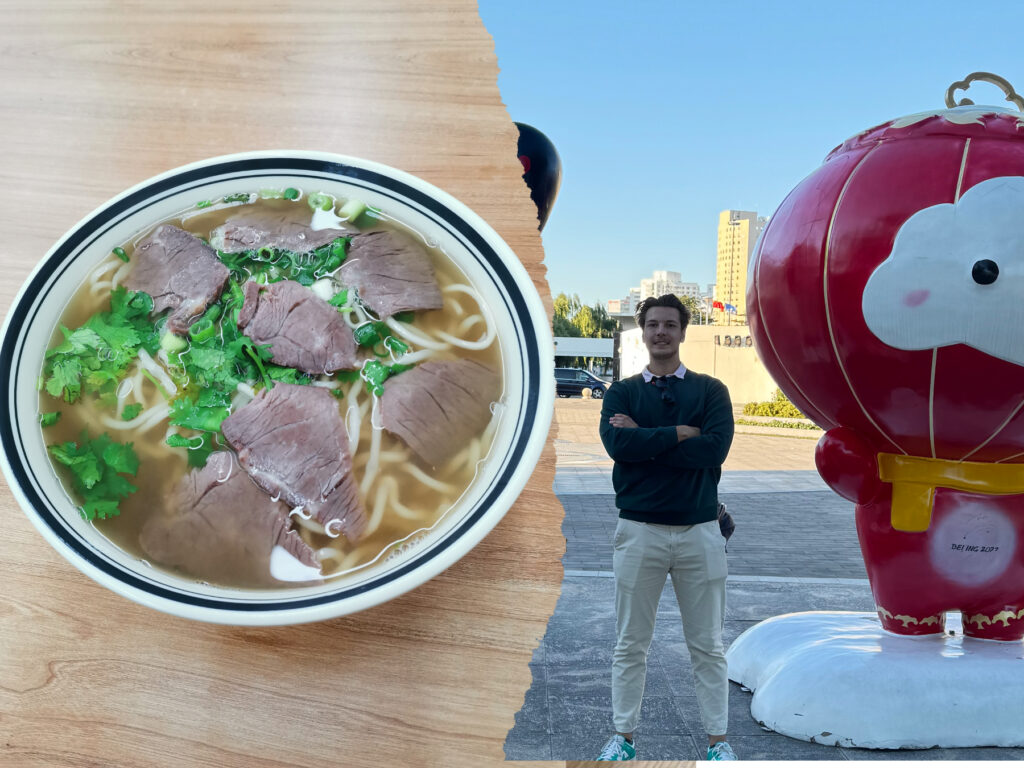
Since it was evening and my stomach was loudly reminding me that I hadn’t eaten properly since the plane, I came across a tiny Chinese restaurant. It ended up being my regular evening spot for the rest of the stay. I ordered a huge, fragrant, and filling bowl of Chinese soup – all for about €2. The lady didn’t speak a single word of English, so I simply snapped a photo of the menu on the wall, showed it to her, and she handed me a QR code. I scanned it using Alipay, the money disappeared from my account, and a few minutes later, I had a steaming bowl of deliciousness in front of me.


After that, I just headed back to the hotel to finally get some proper rest and a good night’s sleep. The next day, we were going to visit probably the most famous part of all Beijing – and on top of that, there was a surprise waiting for us… one we had no idea about. If you don’t want to miss the next chapter of The Flying Eastener, make sure to subscribe to the newsletter and follow me on Instagram!
Cross your boundaries – that’s where the treasure you’re seeking is hidden.
Flying Easterner
 Follow me on Instagram!


氛围绝佳。感谢 感受。